
24 March 2026
The Impact of the Energy Shock in Asia and the Role of Renewables

Andy Yap, Managing Director

Matthew Carpio, Head of Transaction Advisory

Farzana Hoque, Senior Advisor, Thought Leadership & Corporate Communications
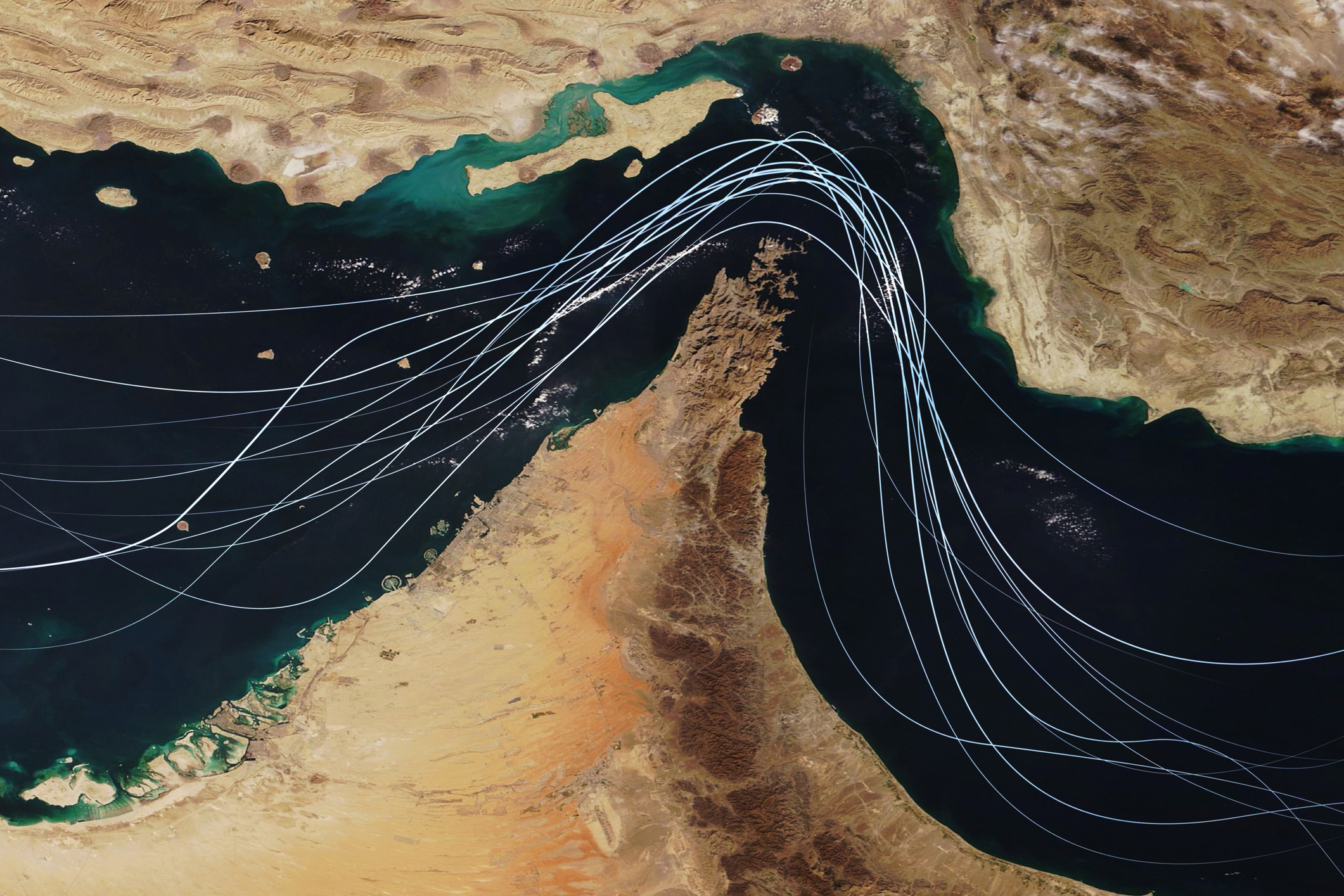
24 March 2026 – As the conflict in Iran and the wider Middle East moves through its fourth week, Asia continues to face an intensifying energy crisis. US President Donald Trump on March 23 announced positive momentum towards a resolution to the conflict, yet it remains and is fluid on a daily basis.
Disruptions to the Strait of Hormuz and surging oil and gas prices are testing the region’s reliance on imported fossil fuels in real time. Prices have eased somewhat following Trump’s announcement, but underlying vulnerabilities remain. Countries that have meaningfully expanded their renewable energy (RE) capacity are already demonstrating a cushioning effect. Our take is that a shift towards clean energy is the strongest safeguard for future stability and affordability.
Energy markets are reeling
Liquefied Natural Gas (LNG) has been a core component of Asia’s energy system, with the region accounting for over 70% of global LNG imports.¹ Around 20% of global LNG supply transits through the Strait of Hormuz, much of it destined for Asian markets, leaving the region highly exposed to disruptions in this corridor.
Prior to the conflict, global LNG markets were moving toward an anticipated period of oversupply, expected to accommodate rising demand from both Europe—shifting away from nuclear and coal toward LNG and renewables—and Asia’s growing energy needs, especially in more developed power markets. The war in Iran has rapidly reversed this outlook, pushing markets back into a significant supply deficit.
LNG flows through the Strait of Hormuz have now slowed to a near standstill, as shipping faces both real and threatened attacks. As a result, Asia’s spot LNG prices have surged to three-year highs.² Moreover, reports suggest that the latest attacks have caused significant damage and will take time to fix. The March 18 attack on Qatar’s Ras Laffan LNG facility for example is estimated to require 3-5 years to repair.³ As such, even if the war ends tomorrow, it will take time to get LNG production and deliveries back to pre-war levels.
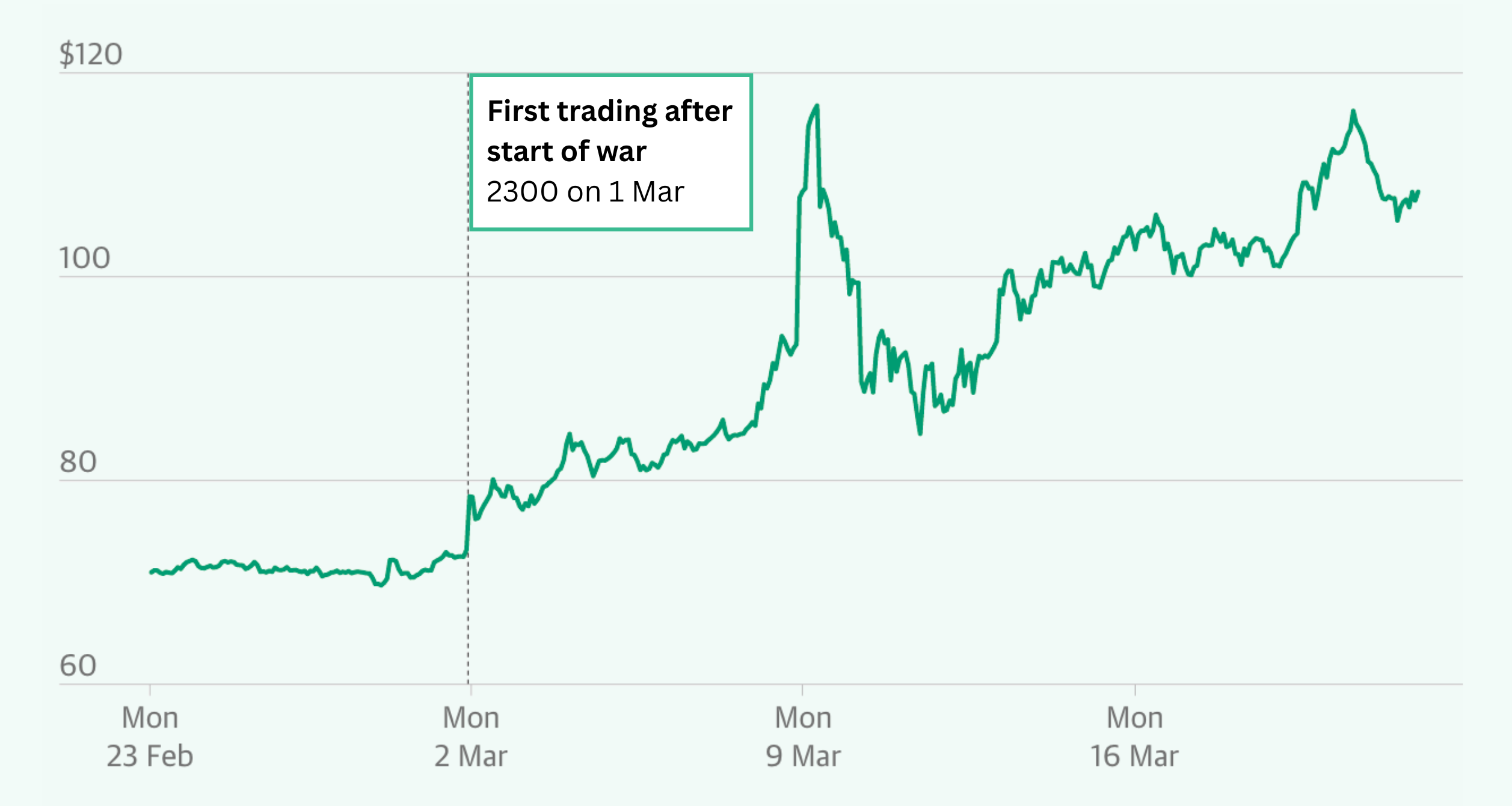
The oil markets have not fared better. Approximately 80% of Asia’s oil imports pass through the Strait of Hormuz, leaving the region highly exposed to disruption.⁴ One analysis has described this situation as the “largest supply shock in the history of the modern oil market…”⁵ Brent crude has spiked above $100 a barrel, up from roughly $70 previous prior to the conflict, and could average at $120 a barrel.⁶ Prices fell below $100 immediately following Trump’s more positive outlook on an Iran resolution.
Sharp Rise in Oil Prices Since the Start of the Iran War
Brent crude, $ a barrel (hourly)
To further add complexity, suppliers and countries are in the process of or expected to tap from their own strategic reserves of fuel to either complete deliveries or accommodate actual demand. Shortages can occur in certain countries if planning and logistics are not able to secure already expensive supply from alternative sources from the Middle East. As the Carlyle Group puts it, “You can’t print molecules.”⁸
With price spikes and volatility, governments across Asia are responding with emergency measures to manage constrained supply and rising costs. For example, Bangladesh has imposed fuel caps and closed universities. Thailand has told state agencies to work from home to reduce fuel demand, and India is using emergency powers to redirect liquefied petroleum gas from industrial users to households.⁹
In addition, the oil and gas shocks have also led some Asian countries to ramp up their coal use to manage short-term energy crunch and protect their economies. This has led to rising coal prices, up 13% this month.¹⁰
Bright spots in renewable energy
A transition to renewable and clean energy remains a key strategy for securing a long-term, stable energy future. Two examples, Pakistan and China, help illustrate this point. While all Asian countries are impacted in some way by the oil and gas shocks, the blow has to an extent been softened in these two countries due to previous shifts to cleaner energy.
Pakistan’s people-led solar boom is a striking example of how renewable energy expansion can help cushion a fossil fuel supply shock. In just five years, the country has imported over 50 GW of solar modules, exceeding the country’s total installed power plant capacity by around 2 GW, with solar now being a quarter of Pakistan’s energy production.¹¹ LNG imports had dropped 40% in the past 2 years, with projected savings of $6.3 billion in 2026 alone thanks to reduced fossil fuel dependency.¹²
China, the world’s largest oil importer, is also feeling the strain of the global oil shock. Yet years of preparation, including a major expansion into renewable energy, have helped mitigate the impact. In 2025, clean energy–solar, wind, hydropower, and nuclear–generated over one-third of China’s electricity.¹³ Some estimates suggest that over half the installed capacity is now from clean sources.¹⁴ As a result, oil and gas account for just over one-fourth of China’s total energy mix.¹⁵
An outlook for cleaner energy
We share five reasons to keep RE as the prime target.
1. Energy security
Domestic renewable energy—solar, wind, and hydropower—reduces dependence on imported fossil fuels and shields economies from price spikes triggered by geopolitical conflicts. Preparation through transitioning to cleaner energy sources is a strategy for hedging on power costs against fossil fuel volatility and long-term energy security.
One estimate suggests that in the absence of power demand growth, growth in solar and wind would compensate for the loss of LNG transported through the Strait of Hormuz in just 9 months.¹⁶
2. Long term energy affordability
Declining clean energy costs are reshaping the region’s energy economics. Solar, wind, and energy storage technologies have become cheaper faster than anticipated as shown in their LCOEs,¹⁷ eroding the cost advantage of fossil fuels. In many Asian markets, renewable energy is already more competitive: in 2023, 96% of new utility-scale solar and wind projects generated electricity at lower cost than new coal or gas plants.¹⁸ Battery energy storage systems (BESS) have also rapidly fallen and are predicted to “keep hitting record lows through 2029,” according to research from Wood Mackenzie.¹⁹
These structural shifts are being reinforced by current market disruptions. The conflict has introduced significant uncertainty into LNG supply, raising the risk of delays or cancellations for new pipeline infrastructure and export facilities that have yet to reach construction. As LNG becomes less competitive in the merit order, this creates an opportunity to accelerate the transition more directly into RE and a smarter grid.
Already, dispatchable solar and wind in Asia is now less than USD 8 to 10 cents per kWh, while hybrid installations with battery energy storage systems (BESS) are already ranging from USD 10 to 12 cents per kWh due to dramatic fall in RE and battery prices. Both RE and RE and BESS contracts are usually designed as stable long term contracts. This is compared to traditional fossil fuel power supply agreements that pass on fuel costs and are fully exposed to increasing global volatility and price shocks.
At the same time, the true cost of fossil fuels is being further amplified by rising risk premiums.²⁰ If the passage remains fraught with danger or becomes technically open but high-risk, elevated insurance and shipping costs are likely to persist, preventing a full return to pre-crisis pricing. Over time, these sustained, risk-adjusted costs will further erode the competitiveness of fossil fuels relative to renewables, which have no fuel price exposure and have significantly lower sensitivity to geopolitical and transport-related risks.
3. Maximizing existing RE know-how and policy frameworks
Many emerging and developed markets already have existing frameworks on deploying RE and smart grids as part of their own long term energy plans. And several governments are now actively reviewing their existing RE programs for faster implementation given delays in implementation of expensive LNG power generation assets. Previous to the conflict, some retail and corporate consumers had already taken initiative in deploying their own behind the meter distributed RE applications and have more reason to do so now.
For example, Pakistan has shown how rooftop solar can be rapidly expanded. Sonia Dunlop, CEO of the Global Solar Council, emphasizes the global readiness for solar expansion: “We have the manufacturing capacity around the world ready to more than double production overnight, possibly even triple it. A large solar farm can be built in six months. A gigawatt of battery storage can be built in just one month. Rooftop solar? Easy. Installed in a day.”²¹
The Global Wind Energy Council (GWEC) has just launched a Wind Action Plan to Break the Cycle of Energy Crises to provide guidance for governments to fast-track plans for wind and renewable energy.²² Countries are stepping up. South Korea, for example, has committed to increasing its renewable share and published accelerated plans for seven new offshore wind clusters.²³
4. Addressing existing grid infrastructure constraints
Emerging markets and some developed economies still rely on legacy grid infrastructure planned, developed, and implemented 30-50 years ago. These systems are already insufficient given the increasing power demand, as well as need for more grid flexibility as more RE is integrated—both behind the meter and at the utility scale. Upgrading of existing grid assets and increased digitalization leading to a smart grid can also lead to long term reduction of transmission costs due to lower curtailment of power generation assets, more efficient distribution of power supply to demand, and faster response during down times. Increased digitization and use of artificial intelligence in forecasting of power demand and weather patterns have already been proven as effective ways of maintaining grid stability and maximizing cheap RE supply (such as solar and wind).
The cost of implementing changes has also been reduced due to improvements in technology and changing business and financing models. Distribution utilities can now access different types of dedicated international and in-country blended financing to lower overall cost of capital in deploying these large scale projects. Hardware and software providers have also begun providing smart grid related upgrades under “asset as a service” or “software as a service” business models making these upgrades more affordable to implement.
5. Cleaner environment
Fossil fuel combustion harms not only the climate, but also air and water quality, land, and biodiversity. Emissions of CO₂, NOₓ, SO₂, and particulate matter contribute to hazardous air conditions in major cities across Asia such as New Delhi and Beijing, driving up healthcare costs and reducing workforce productivity.²⁴
This event is another reminder of the need for a faster transition to more RE from coal and other fossil fuels as increasing volatilities expose us to price shocks. Climate Smart Ventures is actively engaged in this space, partnering with power asset owners, financial institutions, governments, policymakers, and other stakeholders to accelerate the shift from coal and other fossil fuels toward cleaner energy systems. Equally important is ensuring grid readiness and system integration, so that the growing renewable energy capacity can be efficiently absorbed and utilized.
At the same time, clean energy technologies are also affected by the supply chain disruptions playing out from the conflict. Building more resilient, distributed supply networks will be critical alongside a broader focus on energy security.²⁵
Collectively we are experiencing the ramifications of the current energy crisis. Let’s make sure we continue to prepare for the next one.
¹ BNE Intellinews, LNG in Asia: A transitional step on the way to a greener future, July 5, 2025, https://www.intellinews.com/lng-in-asia-a-transitional-step-on-the-way-to-a-greener-future-389545./.
² Reuters, Asia pivots to coal as Middle East conflict chokes LNG supply, March 17, 2026, https://www.reuters.com/sustainability/boards-policy-regulation/asia-pivots-coal-middle-east-conflict-chokes-lng-supply-2026-03-17/.
³ LNG Industry, QatarEnergy provides production update, March 20, 2026, https://www.lngindustry.com/liquefaction/20032026/qatarenergy-provides-production-update/.
⁴ Time, How Trump’s War With Iran Is Impacting Asia’s Economy—and Why That Matters for the World, March 16, 2026, https://time.com/article/2026/03/16/us-israel-iran-war-trump-asia-economy-oil-energy-inflation-recession/.
⁵ Inside Climate News, The Iran War Is Making the Case for Renewable Energy, Experts Argue, March 11, 2026, https://insideclimatenews.org/news/11032026/iran-war-oil-prices-renewable-energy/.
⁶ Fitch Rating, Oil Prices Could Average USD120/bbl If Hormuz Closed for Six Months, March 20, 2026, https://www.fitchratings.com/research/corporate-finance/oil-prices-could-average-usd120-bbl-if-hormuz-closed-for-six-months-20-03-2026.
⁷ The Guardian, ‘The stakes are enormous’: how a prolonged Iran war could shock the global economy, March 22, 2026, https://www.theguardian.com/news/ng-interactive/2026/mar/22/iran-war-global-economy-donald-trump-oil-prices-inflation.
⁸ The Carlyle Group, You Can’t Print Molecules, March 17, 2026, https://www.carlyle.com/carlyle-compass/you-cant-print-molecules.
⁹ Time, How Trump’s War With Iran Is Impacting Asia’s Economy—and Why That Matters for the World, https://time.com/article/2026/03/16/us-israel-iran-war-trump-asia-economy-oil-energy-inflation-recession/.
¹⁰ Bangkok Post, Asia steps up coal-fired power output, March 17, 2026, https://www.bangkokpost.com/business/general/3218640/asia-steps-up-coalfired-power-output.
¹¹ Sonia Dunlop, LinkedIn, https://www.linkedin.com/posts/sonia-dunlop-62868354_surprise-solar-uptake-in-pakistan-cushions-activity-7439687175836798976-zInZ?utm_source=share&utm_medium=member_desktop&rcm=ACoAAAEBYPMBWwHRhsO8YYe2pteeFi1gA3Q0ptI.
¹² Bloomberg, Surprise Solar Uptake in Pakistan Cushions Mideast Energy Shock, March 17, 2026, https://www.bloomberg.com/news/articles/2026-03-17/surprise-solar-uptake-in-pakistan-cushions-mideast-energy-shock?embedded-checkout=true.
¹³ BBC News, The Iran war is causing a global energy crisis – can China withstand it?, March 18, 2026, https://www.bbc.com/news/articles/cyv9lzn0816o.
¹⁴ Ibid.
¹⁵ Ibid.
¹⁶ Thoughts of Chairman Michael, Thoughts on the Strait of Hormuz crisis, March 11, 2026, https://mliebreich.substack.com/p/thoughts-on-the-straights-of-hormuz.
¹⁷ LCOE, or levelized cost of electricity, is defined as “the average total cost of building and operating an energy system over its lifetime, divided by the total energy output produced during that period. It represents the minimum price at which electricity must be sold to break even over the life of the plant.” Source: Science Direct, accessed March 24, 2026, https://www.sciencedirect.com/topics/engineering/levelized-cost-of-electricity.
¹⁸ Energy Tracker Asia, High Costs and Renewables Surge Weaken Asian Gas Demand Forecasts, June 19, 2024, https://energytracker.asia/asian-gas-demand-forecasts/.
¹⁹ Wood Mackenzie, Asia-Pacific battery costs keep hitting record lows through 2029, according to Wood Mackenzie, October 14, 2025, https://www.woodmac.com/press-releases/apac-utility-scale-energy-storage-pricing-report-2025/. Also see decline in BESS prices here: https://www.energy-storage.news/battery-storage-system-prices-continue-to-fall-sharply-bnef-and-ember-reports-find/.
²⁰ S&P Global, Tankers take insurance at record premiums; yet stay away from Hormuz, March 9, 2026, https://www.spglobal.com/energy/en/news-research/latest-news/shipping/030926-tankers-take-insurance-at-record-premiums-yet-stay-away-from-hormuz?utm_source=chatgpt.com.
²¹ Sonia Dunlop, LinkedIn, https://www.linkedin.com/posts/sonia-dunlop-62868354_surprise-solar-uptake-in-pakistan-cushions-activity-7439687175836798976-zInZ?utm_source=share&utm_medium=member_desktop&rcm=ACoAAAEBYPMBWwHRhsO8YYe2pteeFi1gA3Q0ptI.
²² Global Wind Energy Council (GWEC), LinkedIn, https://www.linkedin.com/posts/global-wind-energy-council_icymi-activity-7440321434716962816-MAPq?utm_source=share&utm_medium=member_desktop&rcm=ACoAAAEBYPMBWwHRhsO8YYe2pteeFi1gA3Q0ptI.
²³ Ibid.
²⁴ Energy Tracker Asia, Exposing The Cons Of Fossil Fuels, December 26, 2024, https://energytracker.asia/cons-of-fossil-fuels/.
²⁵ Resources, Energy and the Iran War: What We’re Watching, March 17, 2026, https://www.resources.org/common-resources/energy-and-the-iran-war-what-were-watching/.
About Climate Smart Ventures
Climate Smart Ventures (CSV) is an advisory firm advancing the energy transition in Asia. Our expertise and projects span coal to clean utility-level energy transition, industrial decarbonization, grid transformation, transition finance, and government-level policy recommendations. We also provide ESG and sustainability advisory services, focused on decarbonization and management of environmental and social impacts. Ecosystem building and collaboration are key elements of our firm, which partners closely with the region’s leading corporates and power portfolio owners, investors, off-takers, and others. For more information, visit https://climatesmartventures.com.